



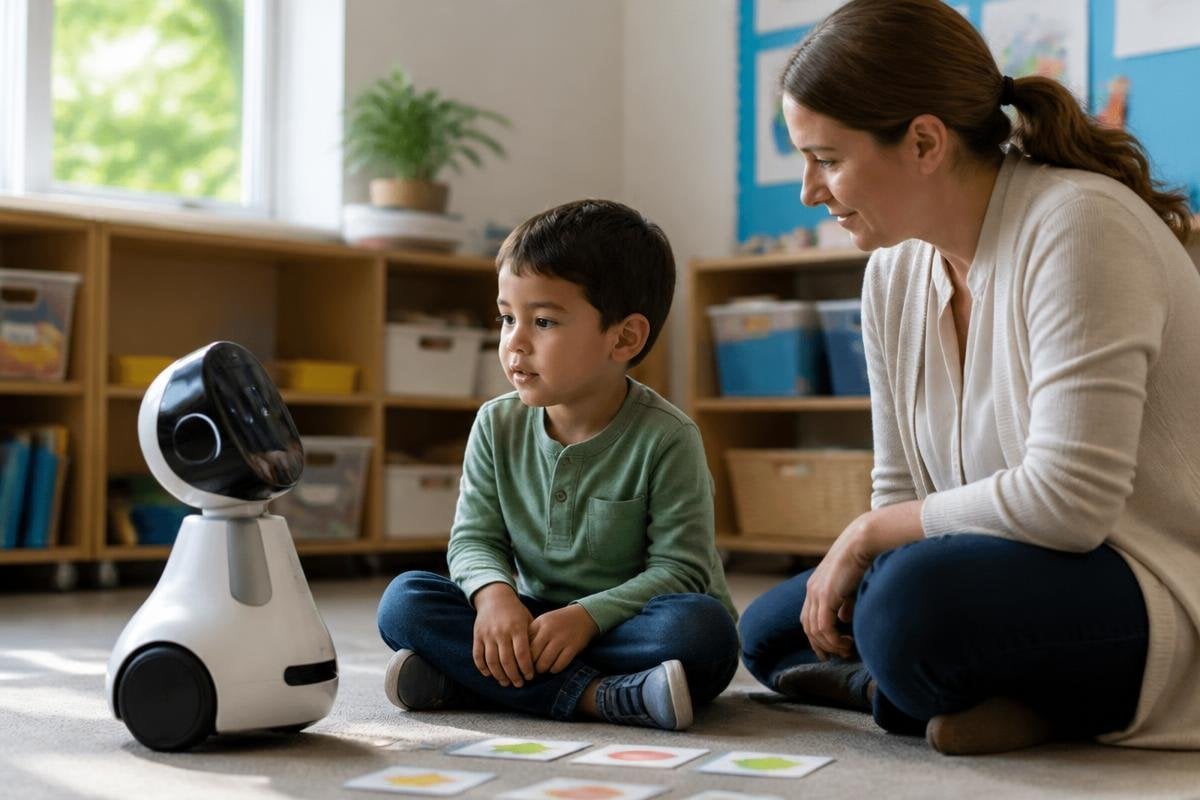
A social robot can ask a child to take a turn, repeat a word, or follow a short activity. That sounds useful, but the machine’s value depends on the task, the adult nearby, and what happens when the robot gets something wrong.
- Use speech, gaze, and turn-taking for short activities
- Keep an adult responsible for teaching and safety
- Treat learning gains as unproven until careful trials measure them
What the robot could do
Early learning includes language, memory, movement, social skills, and basic problem-solving. A robot could guide a small exercise in one of these areas, then give the child time to answer or act.
The machine might say a word and ask the child to repeat it. It could show a picture, wait for a response, and offer a prompt when the child stops.
Sensors could help it detect speech, hand movement, or where the child is looking, though those signals are often hard to read in a busy room.
Turn-taking is another possible use. The robot can speak, stop, listen, and respond within a fixed activity. That structure may help a child know when to act, but a robot can’t judge a child’s feelings or needs with the care of a teacher who knows them.
Why the adult still matters
A social robot should sit inside a lesson, not replace the person leading it. An educator can change the pace, explain a new idea, notice distress, and connect the task to the child’s home life.
It can repeat the same prompt without getting tired. That may help with practice, especially when a child needs several attempts. Repetition alone doesn’t show that the child understands the idea or can use it away from the robot.
A classroom result matters only if the child can use the skill after the robot leaves. Reports on social robots at Robot24.com can tie that result to the task, age group, test setting, and learning measure. That gives the next section a clear test for claims about early learning.
What still needs proof
The main question is transfer. A child may answer the robot during a guided activity and still struggle with the same skill in a book, a group task, or a conversation with another person.
A useful trial would measure the child’s performance before and after the activity. It would also check what happens after the robot is removed, how much adult time the system needs, and whether children with different speech, movement, or attention needs can take part.
Privacy needs the same care. A robot with cameras or microphones may collect speech, images, and movement data. Before it enters a classroom or home, you need clear answers about what the system records, where the data goes, who can view it, and when it gets deleted.
A safe failure mode matters too. If it mishears a child, the activity should pause or ask for another answer. It should never turn a wrong guess into a firm judgment about the child.
A sensible pilot plan
Start with one short activity and one clear measure. A small pilot can show whether the robot helps the lesson or adds work for the adult.
Use this checklist before buying or testing a system:
- Name the skill: Choose one target, such as taking turns or matching spoken words to pictures.
- Set the session length: Keep the activity short enough for an adult to stop it when the child loses focus.
- Write the adult role: Record who starts the task, who gives help, and who handles errors.
- Check the data path: Confirm camera and microphone settings, storage location, access rules, and deletion timing.
- Measure transfer: Test the same skill with a person or paper activity after the robot session.
The last point matters because a robot can make an activity easy to repeat without making the learning stick. I’d fund a system for a narrow task only when a trial shows progress after the robot leaves the room.
That leaves a useful test for every new product: can a child use the skill with a person, a book, or a new task after the robot is switched off?
